An Annotated Portfolio & Project Documentaries

Latest

Seventeen. The Magic Mushroom Table

Putting the finishing touches on "The Magic Mushroom Table"

In this studio photo, I’m applying the finishing touches to a table that took over 500 years to make.

The mushroom’s convex. umbonate cap and base are made of two burls sawn from an ancient Ponderosa pine.  The trunk of the tree was over five feet in diameter.  It was standing dead, and about to fall on a log home, in the mountains between Philipsburg and Georgetown Lake, Montana.  The stem is a section of a burled Lodgepole pine tree trunk from the same area.

The three pieces are joined to create the look of an organic, sculptural whole, as if the table grew into its mushroom shape.  I shaped a tenon at each end of the stem and inset them deeply into mortises cut into the base and cap.  Inserting the burled stem into the burled base required over a hundred tries to achieve a tight fit.  The joinery is reinforced with epoxy filler.

To make the mushroom functional as well as sculptural, I flattened the top of the cap and hollowed out two niches on opposite side of the rim.  (I imagine the table in use between two arm chairs, with a lamp or candle on top, and a wine glass in each niche).

The finish is two topcoats of satin polyurethane applied over two penetrating base coats of Watco Danish Oil.  Each coat revealed the complex swirls and natural colors of the burls’ flowing growth rings and woodgrains.

“The Magic Mushroom Table” weighs over 100 pounds, so I installed four furniture glides under the base.  The finished height is about 27″ and the oval-like diameters of the cap and base average 24 inches.


The table will be delivered to Creighton Block Gallery in Big Sky, Montana, this coming weekend, and be for sale as part of Colin’s and Paula’s gallery exhibition of five pieces of my tree art.

Sixteen. Miscellaneous tree art

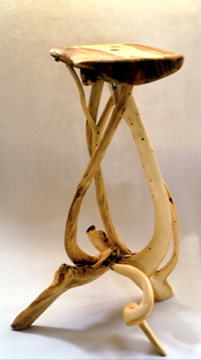
This piece was used onstage as a prop for a live theater performance. It was part of an "underworld" scene. The actor climbed up on it (I was in the audience), and it held her up. The legs are each old Lodgpole tree trunks. The seat is a Lodgpole slab.view shows the end with the Douglas fir burled post closer to the camera. These two photos were taken shortly after the table was placed in the Creighton Block Gallery, downtown Virginia City, Montana. I documented the table making with a blog (35 posts and over 120 photographs). You can visit the blog at http://www.cjackwallerjr.wordpress.com


Both the base and the post of this sculpture stand are of burled Lodgepole pine tree trunks. The top is a cross-cut section of Lodgepole cut after a standing dead tree was felled. The post is deeply inlaid into the base and also inlaid into the top.


The legs are all little (old), gnarly Lodgepole tree trunks. The top is upholstered with leather and tacks. A best friend commissioned this foot stool for his wife. It's now is use in the home in Truth Or Consequences, New Mexico.

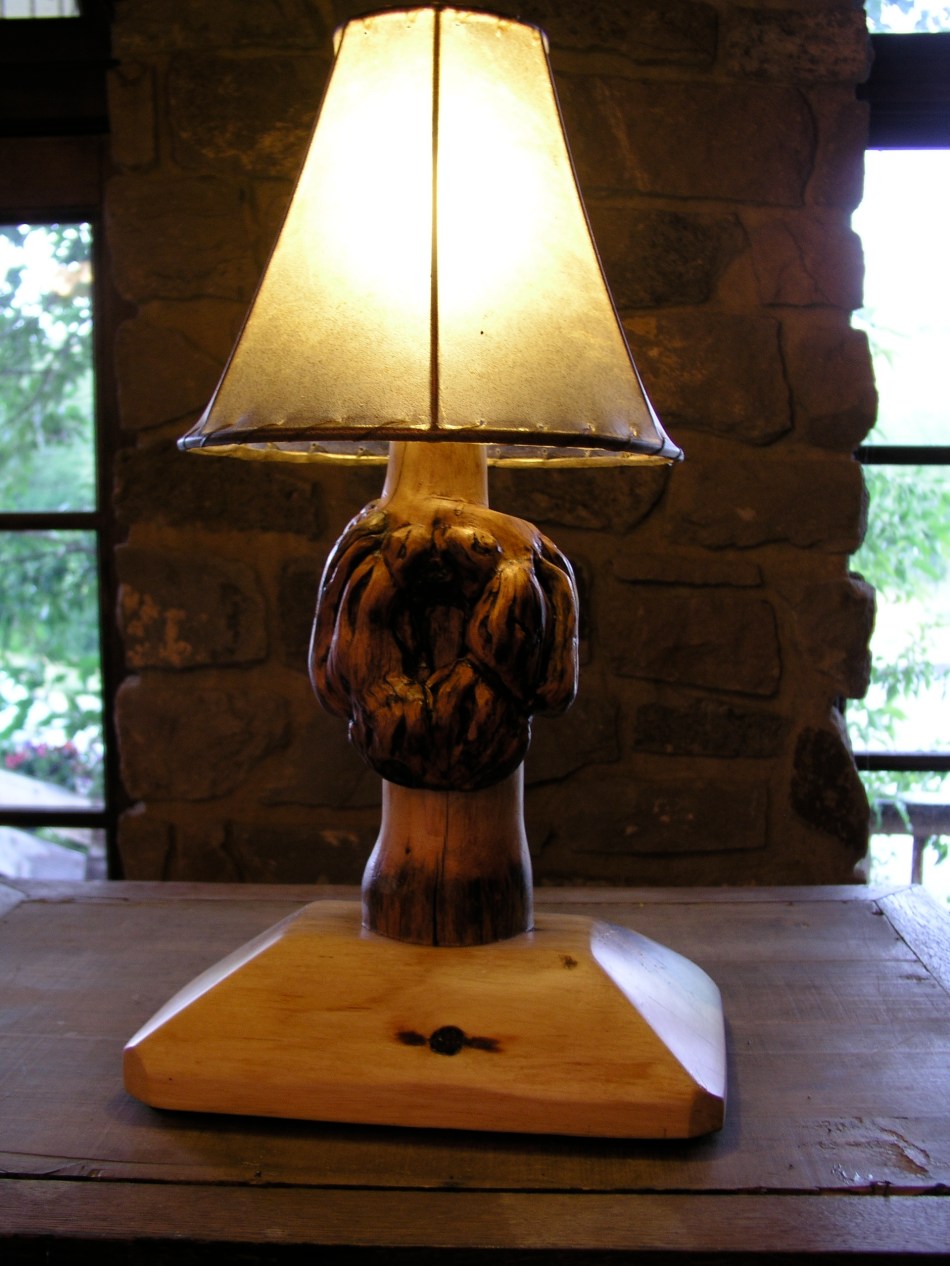
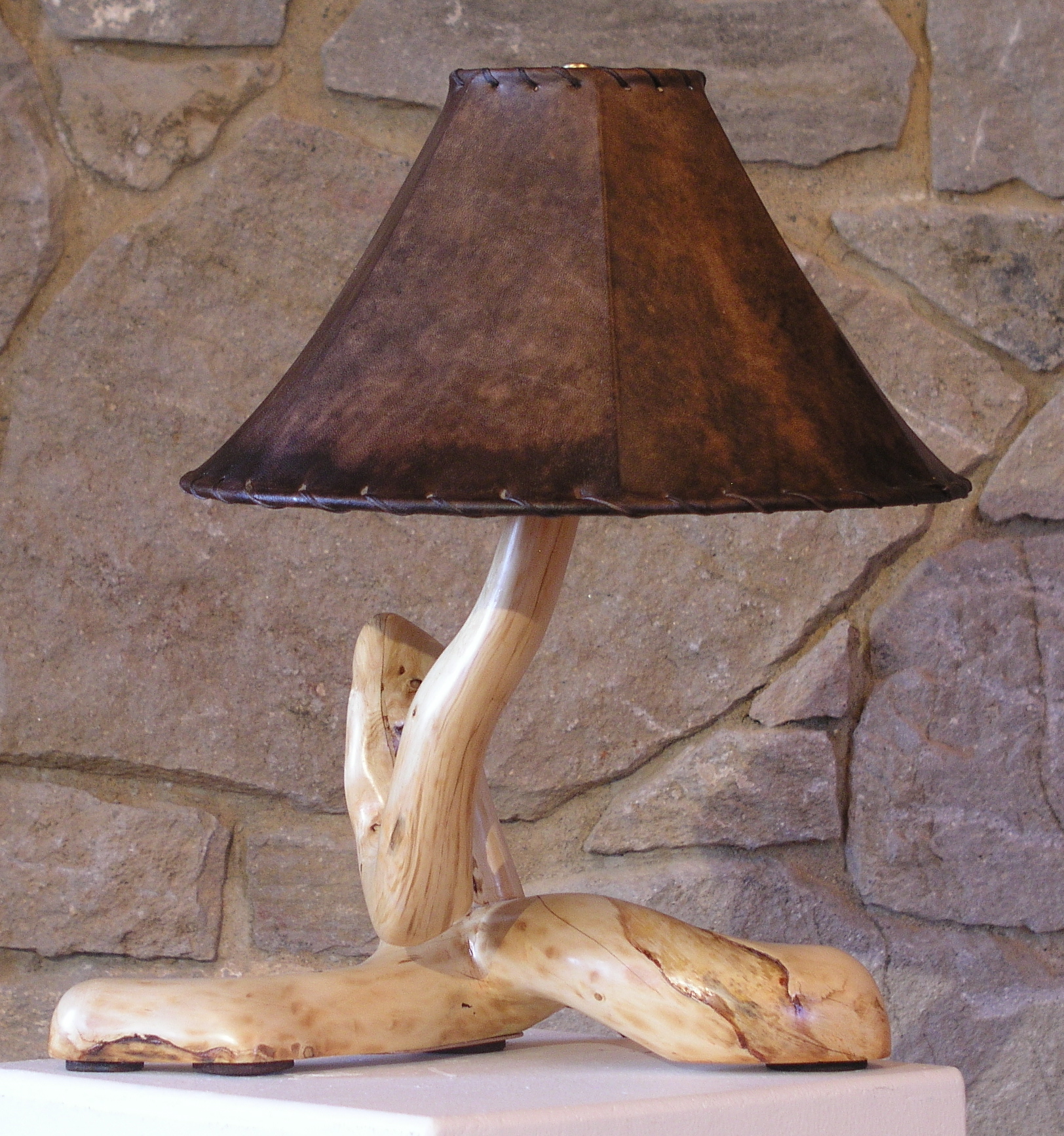
Fifteen. Three lamps


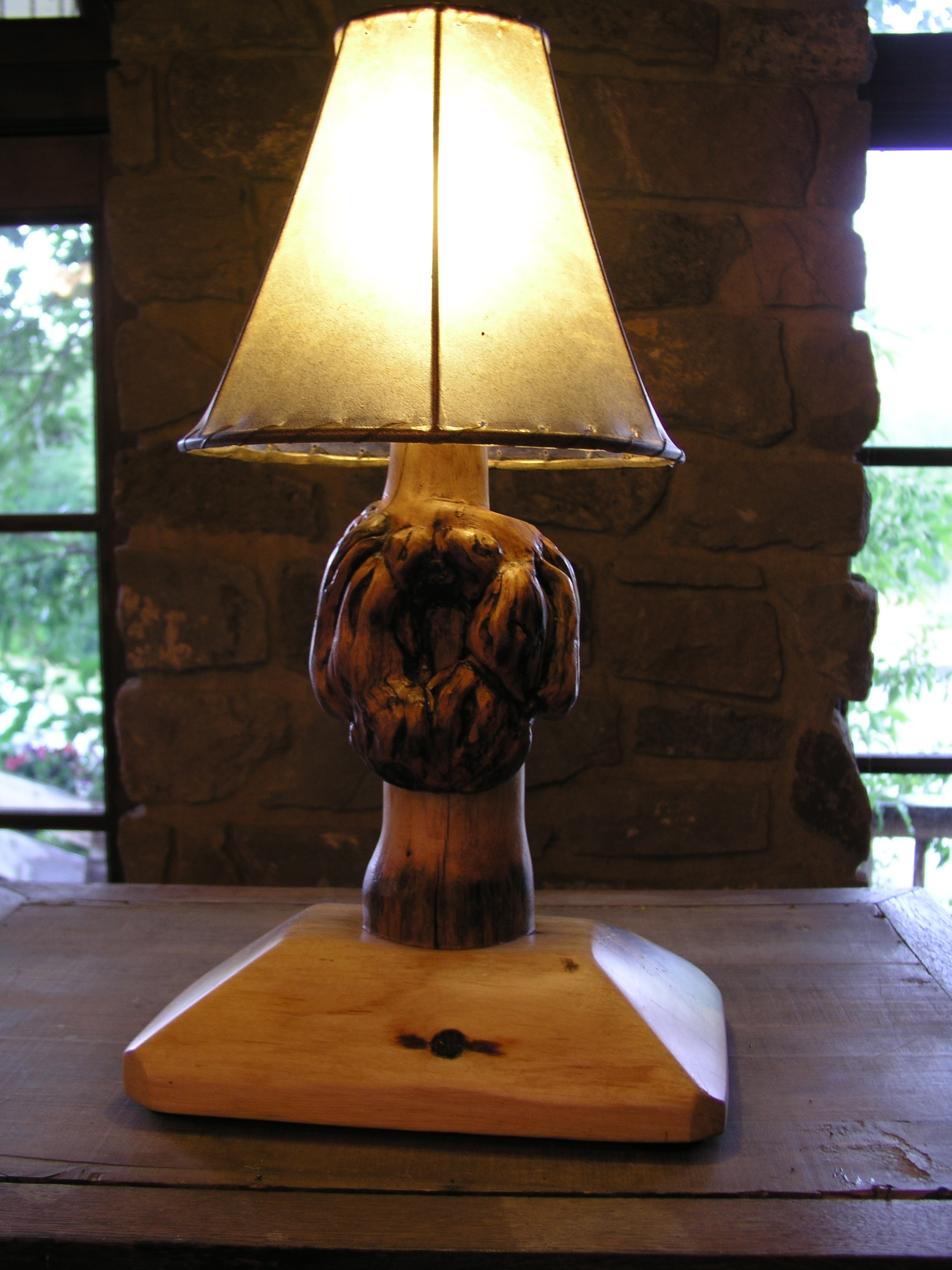
all Lodgepole pine ... base is a crosscut section from the base of a standing dead tree ... the post is a naturally grown "swan's neck" tree trunk .... rawhide lampshade

Lodgepole pine burled post … rawhide shade …l

two Lodgepole pine tree trunks … rawhide shade …

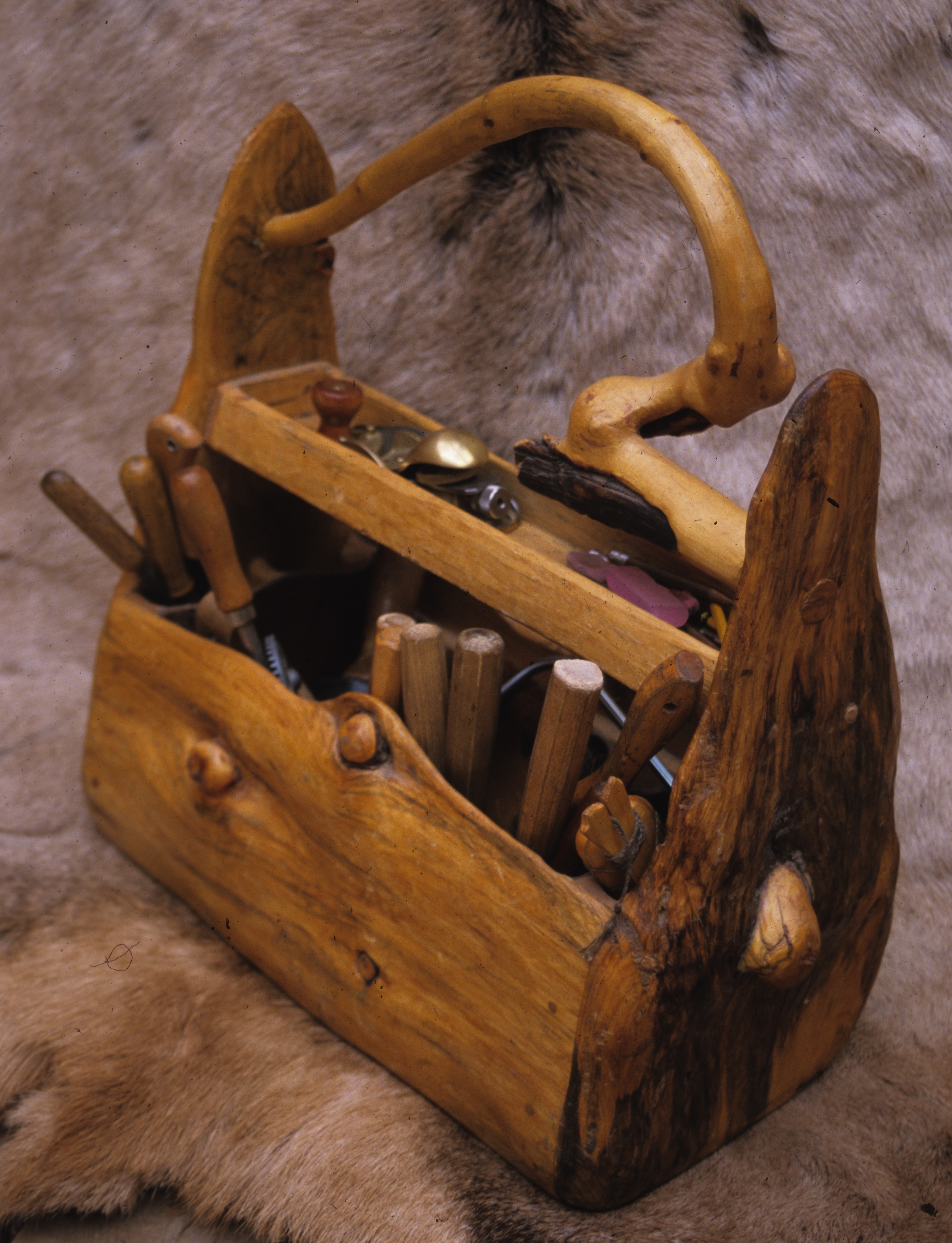
Fourteen. Tree art toteboxes, shaving horse, tool caddy

These pieces, including the ones I’ve kept and used, are as much tree art to me as the commissioned pieces or those I’ve taken to market.

This is the first totebox I made, in 1990 as I remember. I used it for 20 years, and gave it to a good friend last year as a thank-you gift. It's all of Lodgepole, with a tree trunk handle, slab ends and sides. Like all of the toteboxes I've made, the handle is "captive" at each end, joined with round mortises and tenons. No metal fasteners, just dowels and glue.

I'm still using this totebox. The handle is tree trunk, a 100 year old Lodgepole, naturally grown into a dramatic "swan's neck" shape.

I made this totebox for myself, but a man who saw it wanted to buy it just a bit more than I wanted to keep it.

A shaving horse is essential to the makings of tree art. It makes it easy to clamp irregular shapes and quickly unclamp for repositioning. This horse was made for "show" and for portability, so it's smaller than the others I've made. Its design uses a naturally curved section of a Douglas fir tree trunk. The legs are inverted Lodgepole pine tree trunks, naturally forked. The seat and clamp table (leather covered) are Lodgepole. It, along with the tool caddy shown below, is still in use.

This combination of shaving horse and tool caddy were part of my set up when I did public demonstrations, downtown Virginia City. The caddy is made of a hollow Lodgepole section, with inverted Lodgepole forks for legs. Leather straps hold tools.section

Thirteen. Trestle plank dining/conference table

The table top is ten feet long, three feet wide, two inches thick. It is made of three planks--the center one is twenty-five inches wide. The top is removable from the base. Each post is burled, one of Lodgepole pine and the other of Douglas fir. The stretcher between the posts is a Lodgepole tree trunk, joined to the posts at each end with round mortise and tenon joints.

This view shows the end with the Douglas fir burled post closer to the camera. These two photos were taken shortly after the table was placed in the Creighton Block Gallery, downtown Virginia City, Montana. I documented the table making with a blog (35 posts and over 120 photographs). You can visit the blog at http://www.cjackwallerjr.wordpress.com

Twelve. A master bamboo fly rod maker’s bed

This is a queen sized bed I made in the early 1990s, and which sold to a master split bamboo fly rod maker. At the time of the sale his wife told me that he very rarely had a desire to buy anything, especially a piece of furniture. This photo was taken just after the bed was made. All the components are either Lodgepole pine tree trunks or burled Douglas fir. The sides are connected to the headboard and footboard by handmade wood bolts and nuts. In this photo it is covered with a buffalo robe. The most important part of the bed's history (to date) is that the master's father, terminally ill, asked his son if he could die in it. His son said yes, and his father did.

Eleven. “Pagan Dancer”

"Pagan Dancer" is the title I gave to this sculpture because of the mix and movements of the shapes within it.

I named the sculpture “Pagan Dancer”, especially for the figures on the top. The kneeling human leg and hip, the reaching claw, the rising pair of horns combine into one totemic creature, poised in the stillness of an archetypal and pagan dance.  These individual figures/shapes emerged as I pruned, sawed, and rasped on a single piece of “witch’s broom,” a tangle of Lodgepole pine tree limbs.
I had originally intended to make it a functional tree art piece as a base for a table lamp. But as I discovered the human and non-human animal shapes, I sensed it potential to become part of a larger sculpture, an assemblage in which the tree pieces would evoke and symbolize pagan, i.e., pre-Christian motifs.
There is an upward and outward flow to the entire sculpture.  The four pedestal posts suggest sinuous roots rising in and from an underworld, connecting the floor base piece with the undulating, rippling edges of the floating plane and surface from which the dancing figures emerge.
“Pagan Dancer” is made entirely of Lodgepole pine, Pinus contorta var. latifolia, that I found in the forest.  The floor base and doubled plane under the dancing figure are slices cut from the trunk of a standing dead tree.  The pedestal posts are individual tree trunks.
The components were assembled with glued mortise and tenon joiner, dowels, and concealed wood screws.  Only hand-held, non-electric tools were used to shape and smooth the surfaces and edges.  The finish consists of many hand rubbed coats of paste wax, applied over a penetrating oil-based sealer.
I haven’t seen any piece of sculpture that compares with “Pagan Dancer.”  To me, it exudes an other-worldly “Presence” worth of a viewer’s contemplation.


Ten. A commissioned dining room set for Jackson Hole


The table is made entirely of Lodgepole pine. This photo more accurately shows the colors. The top is removable (if you look closely at the underside, you can see the connector notched into the diagonal support). The posts at each end are forked sections of a tree trunk. The extended feet are also tree trunks. The stretcher that connects the ends is a rare growth in which the tree did a complete turnaround to grow upright again.

This chair is at the head of the table, custom made for the man of the house. It uses a lot of burled pieces, a favorite furniture wood in the Jackson Hole, Wyoming area where is shown here in its owner's home.


Nine. Dining chairs


This is another chair from the same dining room set as the two shown below. The burled pieces are fire-killed Douglas fir. The seat is sculpted Lodgepole pine.

These chairs are two of a set of eight, made for a custom order that included a big dining table. I haven’t been able to find a photo of the finished set.

Eight. Guitar player’s chair & music stand

I made the music stand and chair for myself, but a good friend, also a guitar player loved the stand, so I gave it to her. Someone else wanted to buy the chair and did.   The two pieces combine Lodgepole pine and burled Douglas fir.  The fir pieces were fire-kiiled which gives them their rich coloring.  the color in the chair seat is because the tree was beetle-killed.