An Annotated Portfolio & Project Documentaries

Latest

Seven. Dining table–flower motif

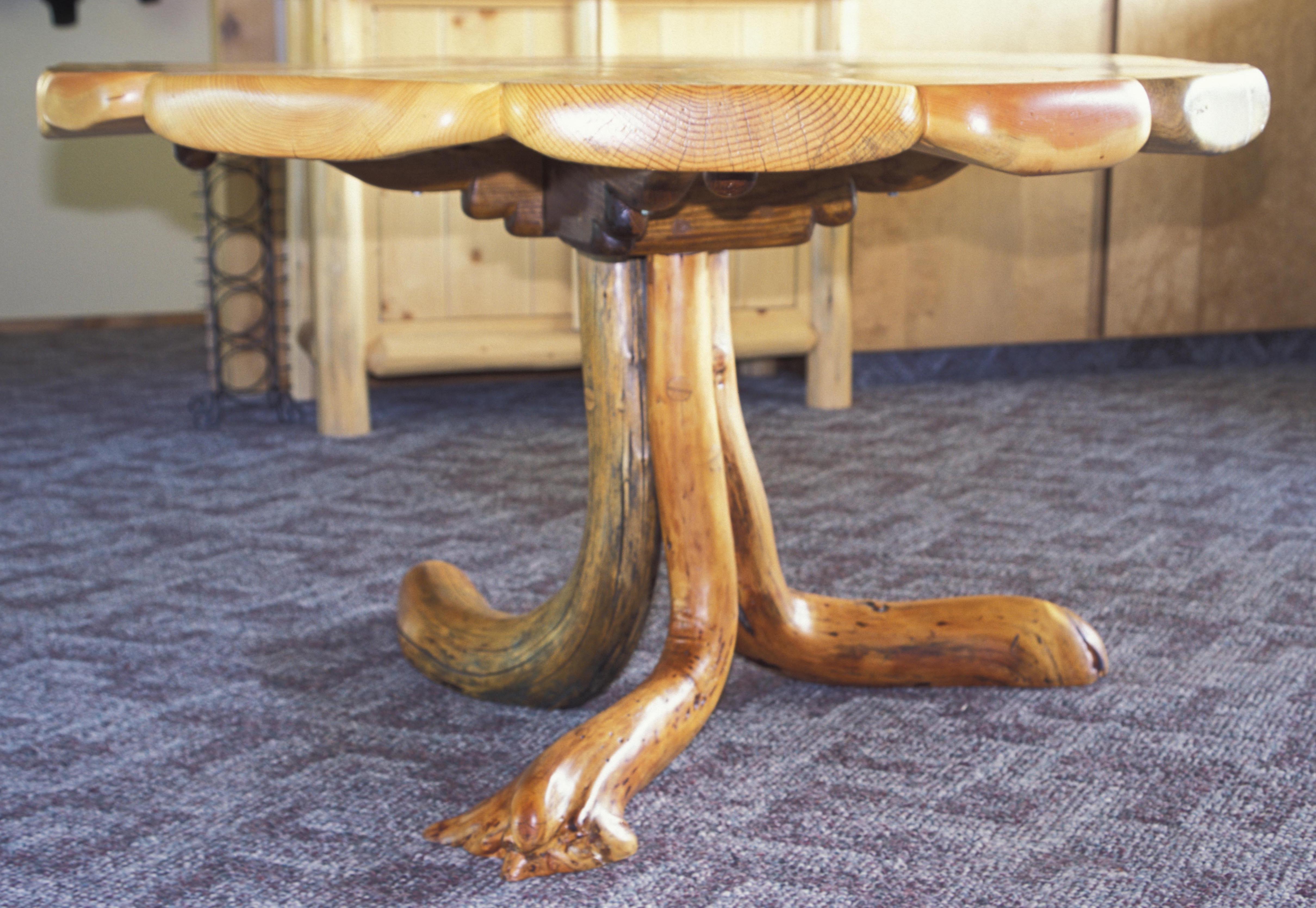
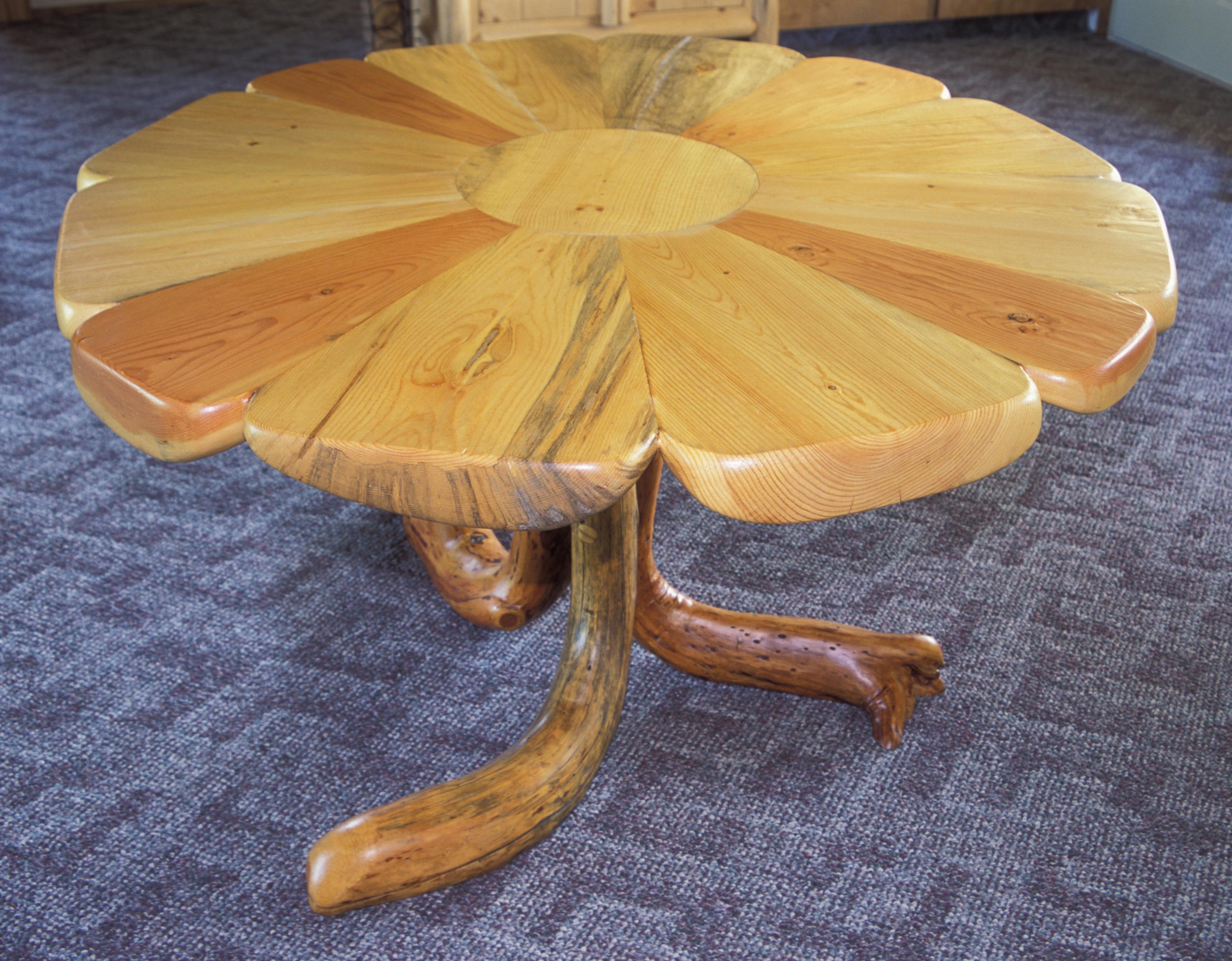
This table has a sunburst top made of eight Lodgepole pine slabs, tapered into the center. Each edge joint was "mate cut by hand, i.e., each saw stroke was cutting two "petals" simultaneously. The top is removable from the base. The three legs are naturally grown, fire-killed tree trunks--one of Lodgepole and two of Douglas fir.

The top has a circle of pine wood inlaid on top of the "petals," which is both a structural and design feature

Six. Selected tables

     Here’s a selection of photos, a small sampling of the many different kinds of tables I’ve made, excluding dining tables. 

This table is made from a section of "The Bee Tree"--a Ponderosa pine that was standing dead (after 500 plus years of life) and hollow, except for a huge colony of honey bees.

This sofa table combines a limb from "The Bee Tree" with a thick piece of glass. It is in the same room as the hollow Ponderosa round table also shown in this post.

A small coffee table with a complicated undercarriage. All the legs and bracings are naturally grown Lodgepole pine tree trunks, joined with dowels, round mortises and tenons, and glue.

The little table at the bottom of the stairs is made of Lodgepole pine--a thick, gnarly slab with four legs made of tree trunks. A thick glass top was cut to match the contours of the slab.

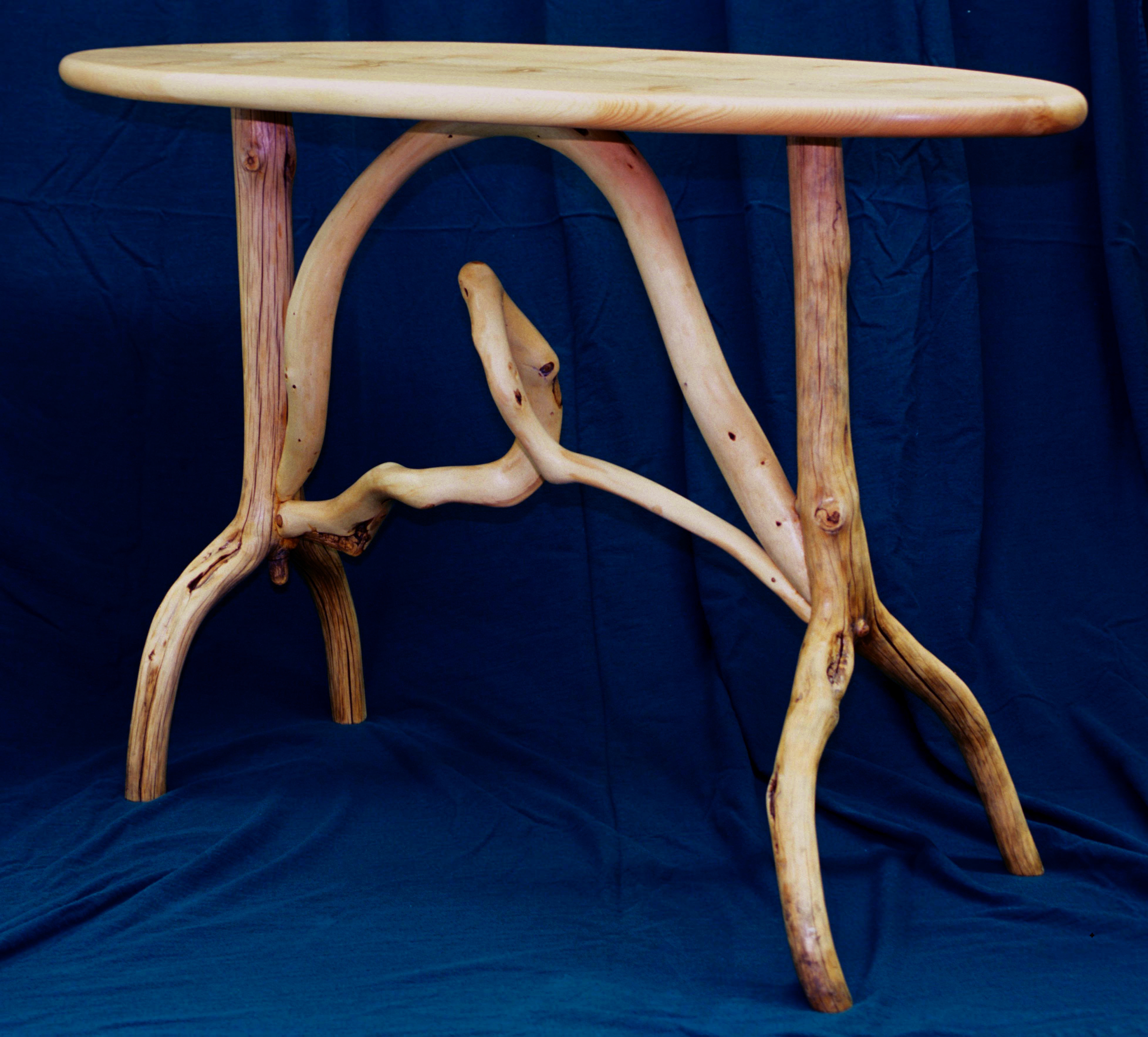
An oval hallway table of Lodgepole pine. The top is a single piece. The legs and bracings are all naturally grown tree trunks. The legs are turned upside down.

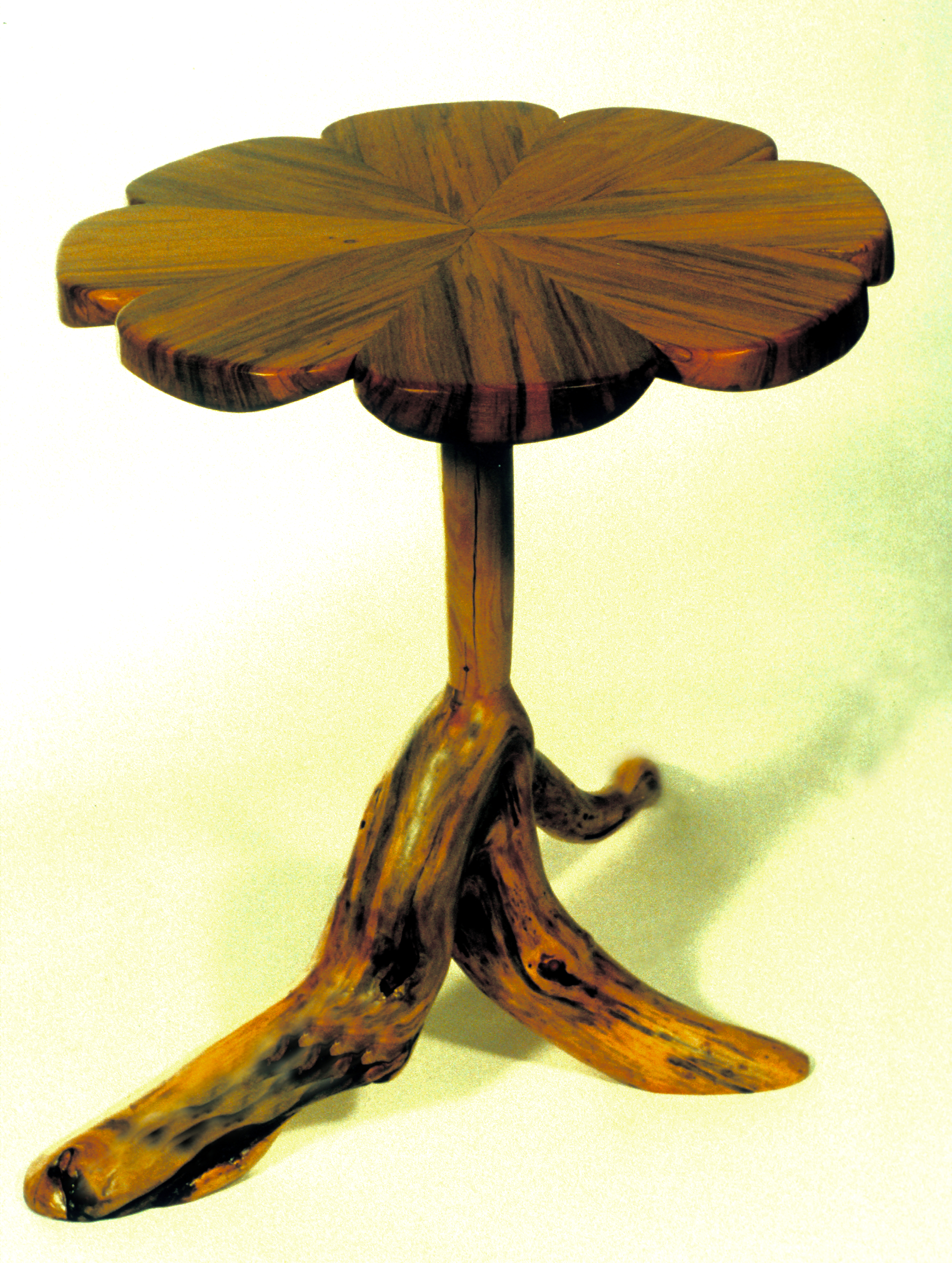
The petals in the top are each a colorful slab of Lodgepole pine, each hand cut to fit its mate on each side. It was made to be a display table at outdoor sports shows, so the top is detachable from the post.

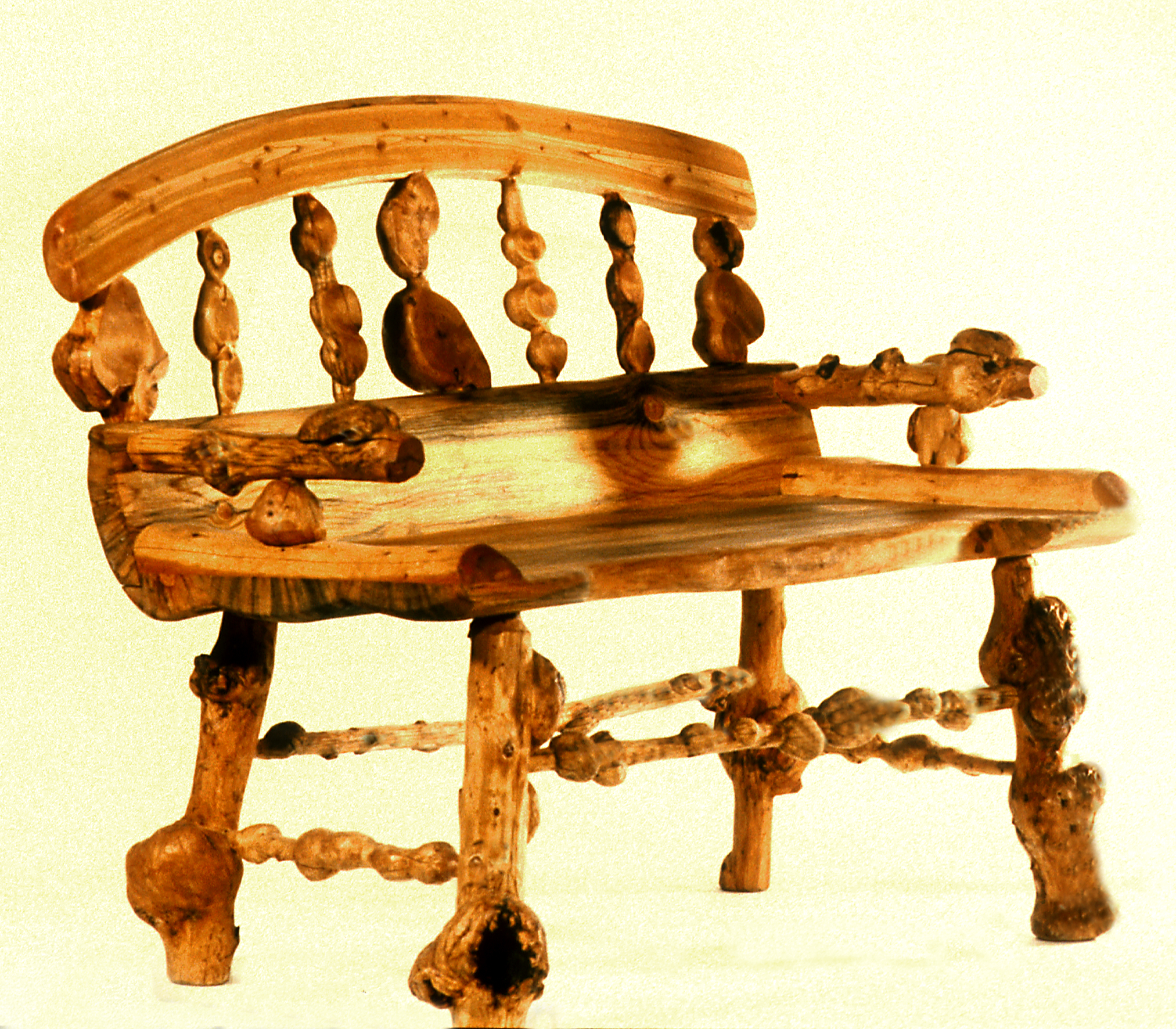
Five. Kaiser House burled settee


This is one of the first tree art pieces I made after moving from Mill Valley, California, to Philipsburg, Montana, in 1989.  It was made for a newly restored, historic building on the main street of town, the Kaiser House, a restaurant at that time.
I found all the burled trees in a stand near Stewart Lake, miles above the town.  It was a small, but enchanted, mountainside.  These days I don’t work much with burls, so that makes pieces like this one special.  The seat and partial backrest are Lodgepole pine planks.  Most of the joinery is hand cut, round mortises and tenons.  The flattened burls on the backrest were quite comfortable.
It was sold years ago, but I still have fond memories of making it.

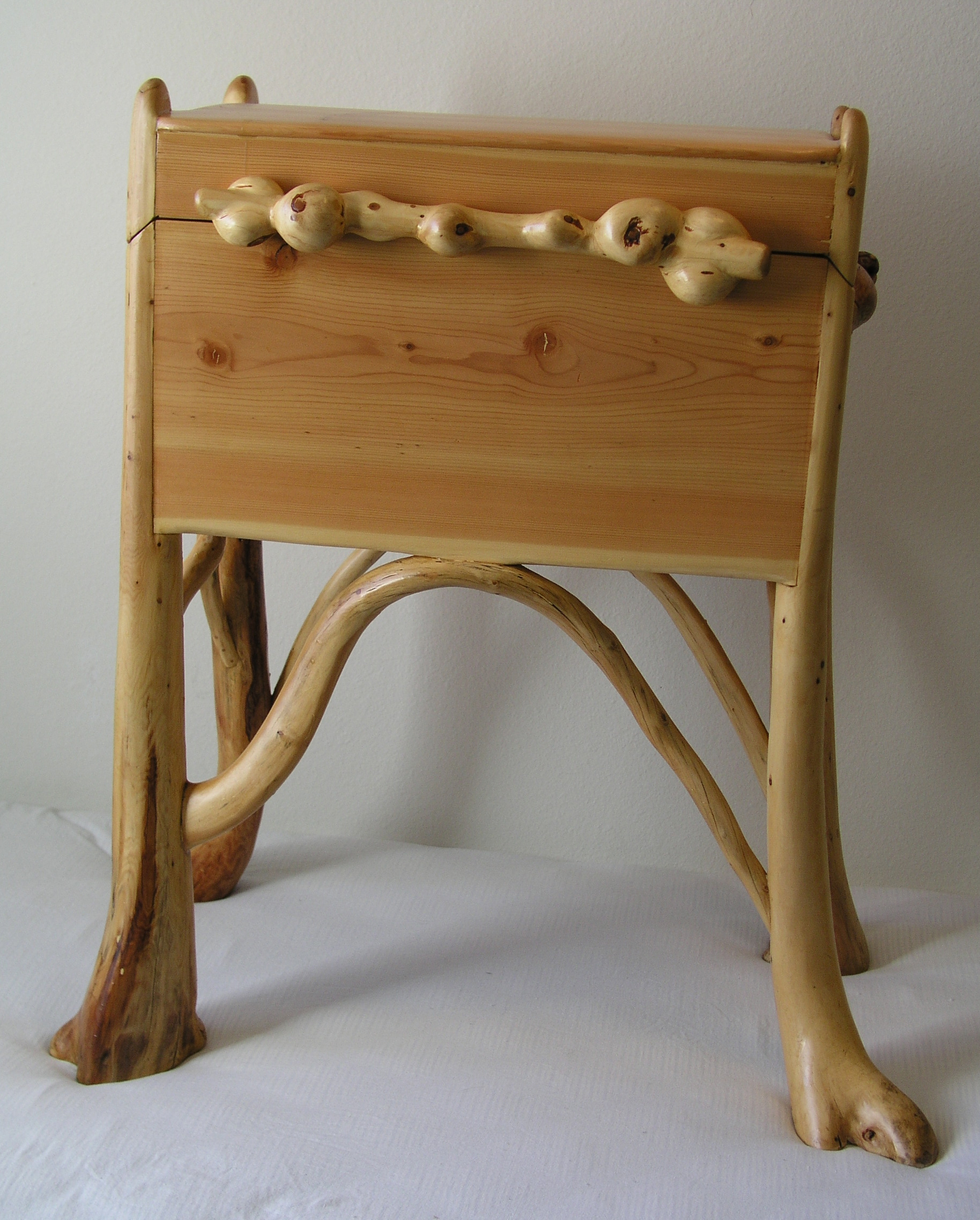
Four. Egyptian Chest

     This freestanding, long-legged, chest was inspired by a photograph of a piece in an ancient Egyptian furniture museum collection.  Perhaps the original was a pharoah’s treasure chest, intended to contain valuables he would need in the afterlife.  Even though I’ve been told that I have a container fetish, I didn’t make this chest with any particular use in mind.
     In addition to making a functional piece of furniture, I wanted to give the chest a sculptural appearance.  Using tree trunk root bases, I imagined the legs and flared feet as suggestive of animal legs, hooves or feet.  

     The box and sliding drawer are made of thin Douglas fir boards.  The legs are fire-killed Douglas fir tree trunks.  The leg braces are naturally bent Lodgepole pine tree trunks.  The box and lid handles are sliced Douglas fir burls.  The lid hinges were hand forged by my good friend and blacksmith, Jon Scott.  The box has a removable bottom, wrapped in suede leather. 

     The joinery includes mate-cut butt joints and rabbets corners, reinforced with dowels and glue.  All of the components are hand planed, scraped, and sanded.  The finish topcoat is a combination of Scandinavian tung oil and satin polyurethane.

Three. The Wizard’s Chair

The story of this chair’s name is part of a book-length manuscript I’ve been working on for the past 15 years, titled The Pagan Tree: A Wizard’s Apology.

The chair is made entirely of standing dead Rocky Mountain Lodgepole pine (Pinus contorta var. latifolia), hunted and gathered in the Deerlodge National Forest near Philipsburg and Georgetwon Lake, Montana.

The seat and backrest are two pieces of slab wood cut from an unusually large tree.  The seat is joined to the backrest with hardwood dowels and glue. Both the seat and backrest were sculpted to accentuate the colorful swirls of grain and the knots.

The backrest was sawn out of a solid, tapered slab, and then sculpted with a carving hatchet, chisels, and rasps to its present shape.

The legs are a matched set of four small, yet old, tree trunks.  If you turned the chair upside down, you could count the growth rings in cross-section on the underside of the feet.  The shapes of the legs are natural, formed as the trees outgrew injury and harsh conditions in the forest.

The joinery includes round mortises and tenons, glued and wedged.  I didn’t use nails, screws, or other metal fasteners.  After many hours of sculpting and hand sanding, I brushed on three finish coats–one of Scandinavian tung oil and two of polyurethane varnish.

The seat and backrest have a special significance to me.  They were first assembled as a legless chair for me to sit on the ground in the tipi where I lived when I first moved to Virginia City in 1995.  The legs and undercarriage were added years later when I decided to create a more functional chair to exhibit in a local art gallery.

I was delighted when the chair was purchased by a wonderfully eccentric poet, a lover of children, a maker of musical instruments, and an awesome  inventor/scientist.  In one word, a wizard …!

One. C. Jack Waller, Jr. — My Tree Art Portfolio

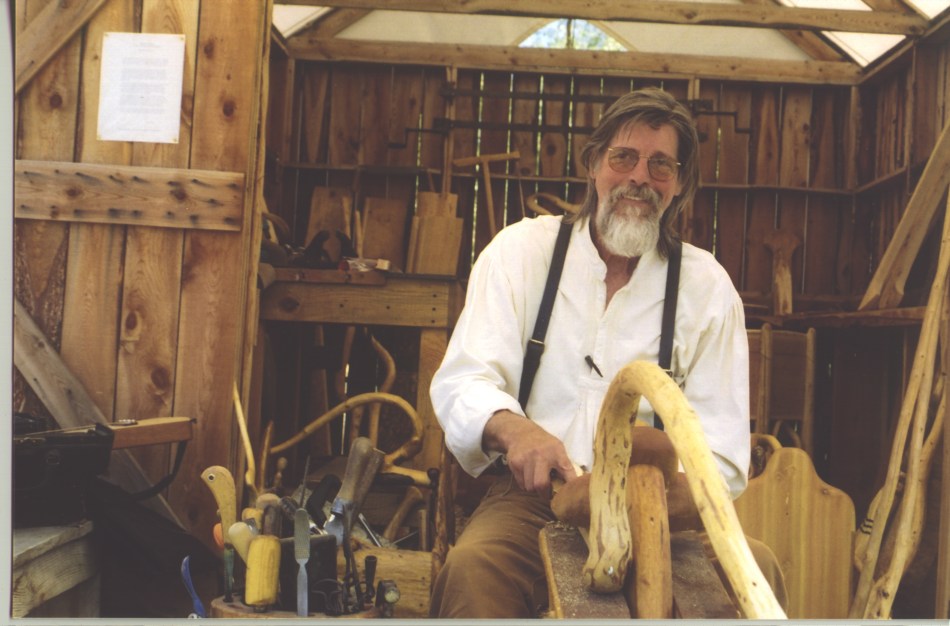
This website presents a documentary of my tree art in an online portfolio, with a collection of photos and text illustrating my work as a tree artist over the past twenty years.  The photo above shows me at work in a demonstration setting, downtown Virginia City, at work on my shaving horse with a tool caddy at my side and some “wigglies” in the background.  It’s a favorite, and definitive, portrait and I thank Marge Antolik for taking it.

This is my recently revised (March 8, 2011) Artist’s Statement:

I’ve worked with architectural design, construction, and furniture making since the late 1960s, when I also made my first rustic furniture of California’s north coast driftwood.
In 1989 I moved to southwest Montana, to live a life of creative and contemplative poverty, centered around daily practices of writing, music, and tree art.  In a word, I chose to be a poet (etymologically, a “maker”), whose poetry (“makings”) includes a tribute to some remarkable trees.

Tree art begins with the extraordinary, usually standing dead, trees I find in my surrounding forests.  As a hunter–gatherer of trees, I’m especially fascinated with contorted lodgepole pine–Pinus contorta var. latifolia.  These pines grow into gracefully deformed shapes as they overcome injury caused by crowded and harsh conditions: dense stands and shaded slopes;  burdens of gravity, the weight of fallen peers in a jackstraw pile, and of drifted snow;  blasts of icy, wintry winds.  I don’t know of another tree species with trunk shapes naturally grown in such a variety of curvilinear twists, curls, forks, and crooks.  Curiously, the common name of “lodgepole” suggests only the straight, narrow, supple poles of the Indian tipi, while the scientific name, Pinus contorta, perfectly describes the trees I work with.

I call myself a treeworker, not a woodworker, because I prefer to work with the original tree shapes rather than a tree processed into wood, i.e., dimensioned lumber.  I work mostly with hand-held tools, which is a very different process than delivering lumber to stationary machines that do most of the work.  Treeworking is essentially slow, quiet, thoughtful, very experimental with a great deal of trial and error.  The making of each piece proceeds, almost ceremonially, using primitive/contemporary tools and skills to achieve sculptural effects.

The challenges of making tree art are to find, select, combine, join, and assemble naturally grown tree shapes into an artifact of my own design and making.  This is not “Art, as opposed to Nature”, as art is often defined, but a thoughtful collaboration of artist/poet with Nature.  In each piece, I attempt to honor and enhance both the physical and figurative character of each component tree–including what I consider to be its life story, in fact, its autobiography.